
Deck lighting in Central Pennsylvania changes the way a deck is used more than almost any other single upgrade. A deck without lighting is a daytime-only space. A deck with well-planned lighting is a genuine outdoor room that is available for morning coffee at 6am, evening dinners at 8pm, and everything in between across Central Pennsylvania’s seven-month outdoor season. According to Northern Building Supply’s 2026 deck lighting guide, thoughtfully designed outdoor lighting can turn a basic platform into a cozy retreat, a lively entertaining space, or a peaceful spot to unwind at night. Industry data cited by multiple deck building sources consistently shows that built-in deck lighting systems add 15 to 20 percent to a deck project’s overall return on investment. That return comes from daily use value, not just resale impact.
Why Deck Lighting Matters in Central Pennsylvania Specifically
Central Pennsylvania’s outdoor season runs from late April through October, approximately seven months of genuinely comfortable weather. During that window, evening temperatures in June, July, and August settle into the mid-60s after 9pm, which is among the most comfortable outdoor weather of the entire year. A deck without lighting loses all of those evening hours. A deck with lighting makes them among the best hours of the day.
For families in Mechanicsburg, Dillsburg, and surrounding communities who use their decks actively across this season, the difference between a lit deck and an unlit one is measured in dozens of additional outdoor evenings per year. That is where the enjoyment return on deck lighting is most immediate and most meaningful.
Safety is the other practical driver. Stair lights and perimeter lighting prevent the trips and falls that occur on unlit decks after dark, particularly on stairs and level changes. For families with children, older adults, or regular evening guests, safety lighting is not an aesthetic consideration. It is a functional requirement.
West Shire Decks builds custom decks with integrated lighting systems throughout Mechanicsburg, Dillsburg, York PA, Monkton MD, and surrounding Central Pennsylvania communities. As Central PA’s only TimberTech Platinum Certified Contractor and a six-time winner of Harrisburg Magazine’s “Simply the Best” award from 2020 through 2025, their team designs lighting as part of the overall deck plan rather than treating it as an afterthought.
The Three Layers of Deck Lighting
Effective deck lighting uses three distinct layers that work together to create a space that is both functional and atmospheric. Understanding these layers before planning your lighting scheme produces a result that serves every use scenario rather than one that is either too dark for practical use or too bright for comfortable relaxation.
Ambient lighting is the base layer that provides overall illumination of the space. This is the light that allows you to see faces across the deck, move safely without looking at your feet, and perceive the full extent of the outdoor space. Post cap lights, overhead string lights, pendant fixtures, and perimeter under-rail systems all contribute to ambient light. A well-lit deck starts with enough ambient light to make the space genuinely usable at night rather than merely visible.
Task lighting focuses on specific activity areas that require more directed illumination than ambient light provides. Cooking and grilling areas benefit from brighter, focused light over the grill and preparation surface. Dining zones benefit from overhead lighting that illuminates the table clearly without creating harsh glare. Stair lighting is a specific form of task lighting that ensures each step is clearly defined for safe navigation.
Accent lighting highlights specific features of the deck or adjacent landscape to create visual depth and interest. Uplighting at post bases, lighting beneath built-in bench seating, and landscape uplighting around the deck’s perimeter all contribute to the layered visual depth that makes a well-lit deck feel designed rather than simply illuminated.
According to Coowin Group’s outdoor deck lighting planning guide, the right deck lighting uses all three layers together. Start with step lights on every stairway, add post cap or railing lights for perimeter visibility, then layer in string lights, pendants, or under-rail systems for atmosphere. That sequence produces a complete lighting scheme rather than a collection of isolated fixtures.
Step Lights: The Most Important Safety Element
Step lights are the single most functionally important element in any deck lighting plan. Stairs are the most common location for deck-related injuries after dark, and clearly lit stair risers prevent the visual confusion that causes people to misjudge step location in low-light conditions.
Step lights are installed in the vertical face of each stair riser, producing a soft downward glow that clearly defines each step without creating glare that would compromise vision higher up. Recessed step lights sit flush with the riser face for a clean, integrated appearance. Surface-mounted step light covers sit proud of the riser but are easier to retrofit to existing stairs without routing.
Post-cap lights, side lights, and stair lights are now sealed LED units. Each one draws roughly a watt and a half and is rated for about 40,000 hours of use. At eight hours a night, that is well over a decade of service with no bulbs to replace and almost no effect on your power bill. Low-voltage LED step lights run from a transformer that can be set to operate automatically at dusk and shut off at a timed interval after sunset.
On any deck with stairs, step lights are not optional if the deck will be used after dark. Their safety function is matched by their design contribution: a staircase with evenly illuminated steps reads as finished and intentional in a way that an unlit stair does not.
Post Cap Lights: Ambient Perimeter Lighting
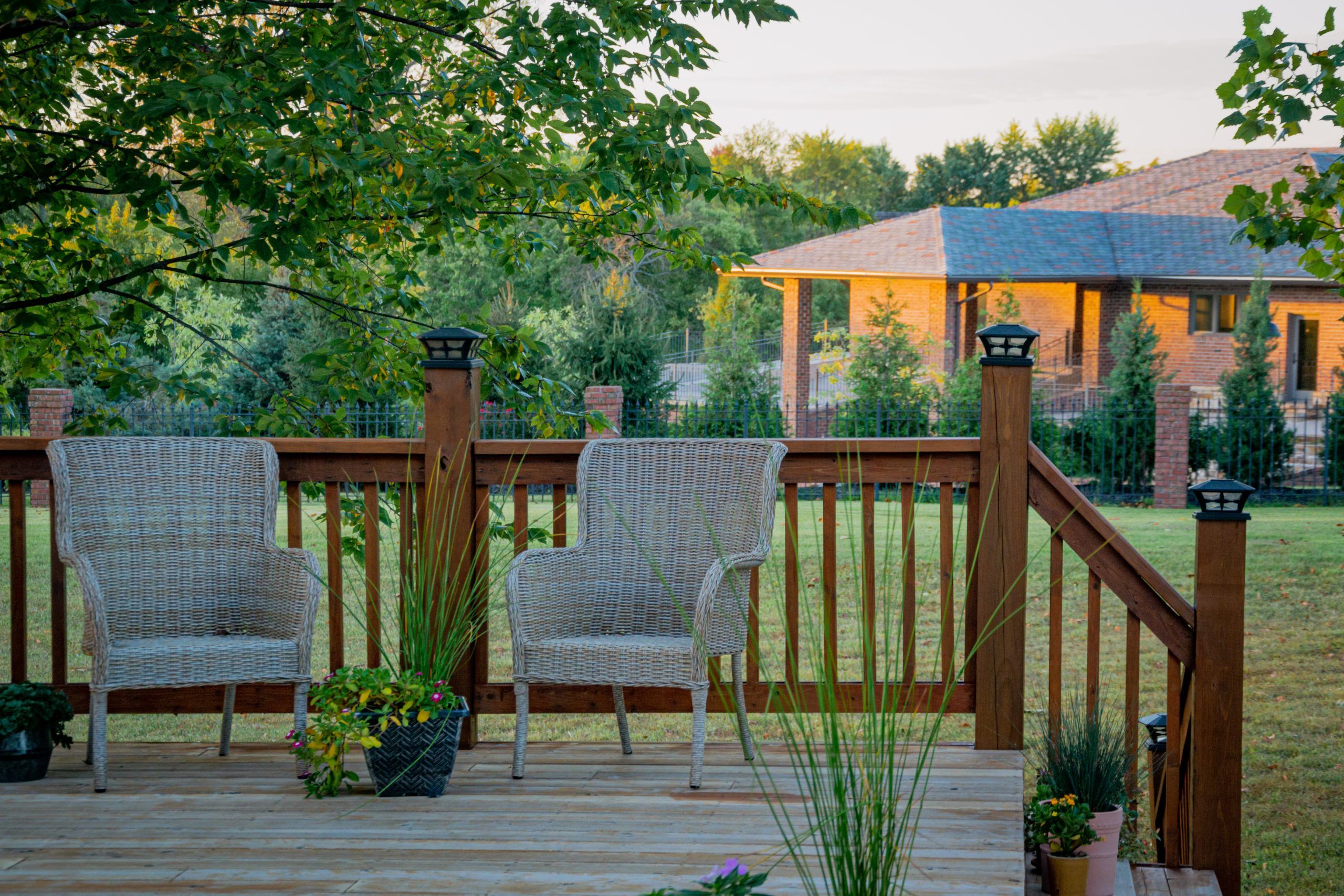
Post cap lights replace standard post tops on railing posts, providing ambient lighting that defines the deck’s perimeter at eye level. They come in solar and low-voltage options, with styles ranging from traditional to contemporary, and they function as both mood lighting and edge definition that helps people perceive the deck’s boundaries after dark.
Post cap lights produce soft, downward-directed ambient light that is visible from inside the home as well as from the deck itself. From indoors, a deck with illuminated post caps reads as an inviting extension of the living space rather than a dark void beyond the sliding door. That visual connection between interior and exterior is one of the understated benefits of post cap lighting.
Low-voltage post cap lights wired into the deck’s lighting system are more reliable and consistently brighter than solar post cap alternatives. Solar caps depend on adequate daily sun exposure to charge effectively, which is inconsistent in shaded backyard locations or during the cloud-heavy days that Central Pennsylvania’s fall season produces. For a deck that will be reliably lit every evening, low-voltage wired post caps are the better investment.
Post cap style should be coordinated with the railing system. Traditional post cap profiles suit traditional railing systems and architectural styles. Low-profile contemporary caps suit aluminum, cable, or glass railing systems where a slimmer, more refined fixture reads as architecturally consistent.
Under-Rail Lighting: Clean Lines and Continuous Glow
Under-rail lighting installs LED strip fixtures or individual lights beneath the railing’s bottom rail, casting indirect light downward across the deck surface. The result is a continuous, even glow along the deck’s perimeter that illuminates the surface without creating direct glare from visible light sources.
The current trend in deck lighting is moving strongly toward discreet, integrated fixtures. Slim linear fixtures mounted under the railing, hidden from view, throw indirect light across the deck surface. You see the light, not the light source. That sleek, tucked-away look is where most of the demand is heading among Central Pennsylvania homeowners who want a contemporary and refined lighting result.
Under-rail lighting creates a floating visual effect from the yard, where the illuminated deck surface appears to glow softly without an obvious source. This effect is particularly striking on elevated decks where the under-rail light reaches the space between the deck and the ground below. For deck photography, evening photos with under-rail lighting consistently produce the most visually compelling results.
Under-rail strip lights must be installed before the decking boards are finished so the wiring can be routed properly through the framing without surface-mounted conduit runs. This is one of the clearest reasons why deck lighting should be planned at the design stage rather than added after the deck is complete.
Integrated Lighting: Built-In Versus Retrofitted
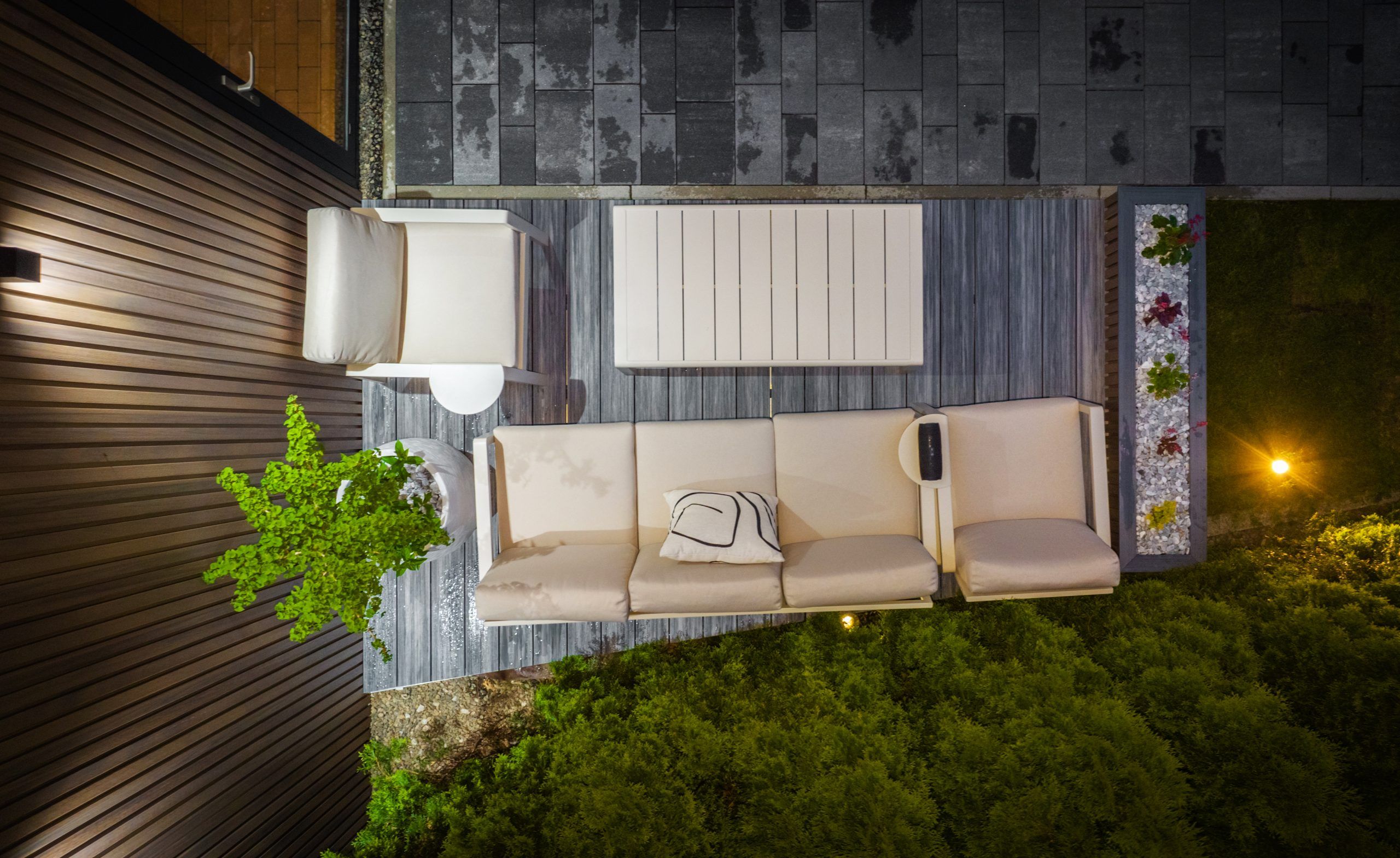
The distinction between integrated deck lighting and retrofitted lighting is one of the most significant quality and aesthetic differences in the category. Integrated lighting is designed into the deck from the start. Wiring is routed through the framing before decking boards are installed, conduit runs are hidden within structural members, and fixtures emerge cleanly from their mounting surfaces without exposed wiring or surface-mounted cable runs. Retrofitted lighting is added to an existing deck surface through surface-mounted conduit, clip-on fixtures, and visible cable runs that are rarely as clean as integrated installation.
The investment in planning lighting during the design phase pays off in a significantly cleaner finished result. A post that has conduit running through its interior to a post cap light looks fundamentally different from a post with surface-mounted conduit stapled to its exterior leading to the same fixture. The difference is visible from the yard, from the deck, and in every photograph taken of the finished space.
For homeowners building a new custom deck in Mechanicsburg or anywhere across Central Pennsylvania, planning the complete lighting scheme before construction begins is the most cost-effective approach to achieving integrated lighting quality. For homeowners with an existing deck who want to add lighting, the deck upgrades service at West Shire Decks includes lighting installation as a standalone service, with installation methods that achieve the cleanest possible result given the existing structure.
Choosing the Right Color Temperature
Color temperature, measured in Kelvin, determines whether deck lighting reads as warm and inviting or cool and functional. This decision significantly affects the atmosphere the lighting creates and should be made deliberately rather than defaulted to whatever fixture is available.
Warm white lighting in the 2700K to 3000K range produces the amber-toned glow that most people associate with inviting outdoor spaces. At this color temperature, deck lighting reads as relaxed, warm, and atmospheric. It complements wood tones and warm composite board colors and creates an ambiance that is well-suited to dining and relaxation.
Cool white lighting in the 4000K to 5000K range produces a cleaner, brighter light that reads as functional rather than atmospheric. At this color temperature, deck lighting is better suited to task areas including cooking and food preparation zones where accurate color perception and visibility are priorities over ambiance.
For most Central Pennsylvania decks where the primary lighting goal is extending evening use for dining, entertaining, and relaxation, warm white in the 2700K to 3000K range is the appropriate baseline. Task lighting over grilling and cooking areas can step up slightly in color temperature without affecting the overall atmospheric character of the space.
According to Coowin Group’s deck lighting planning guide, sticking with warm white LEDs in the 2700K to 3000K range is the standard recommendation for residential deck lighting, with the caveat that task areas may benefit from slightly cooler and brighter task-specific fixtures.
String Lights and Overhead Lighting
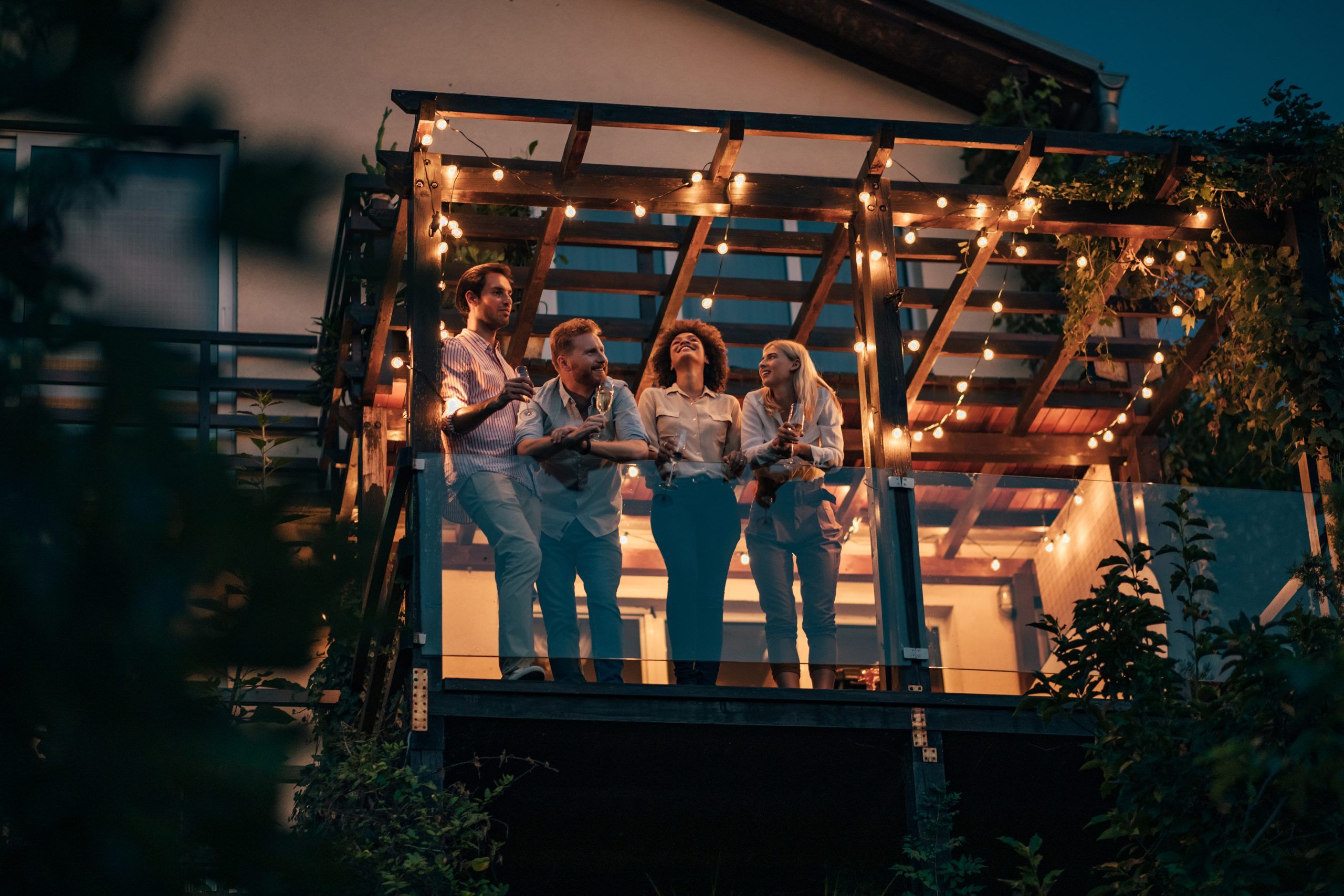
String lights provide the overhead ambient light layer that gives a deck the warm, festive character that makes evening entertaining feel genuinely special. Suspended between pergola rafters, stretched between posts along the deck perimeter, or draped across an overhead structure, string lights create a visual ceiling for the outdoor space that makes the deck feel enclosed and intimate without blocking airflow or natural light.
Modern outdoor string lights use LED bulbs that produce the same warm glow as traditional incandescent bulbs at a fraction of the energy consumption and with a significantly longer service life. Commercial-grade outdoor string lights are weatherproof and rated for continuous outdoor exposure, which is important in Central Pennsylvania’s wet spring and fall conditions.
String lights work most effectively in combination with lower-level integrated lighting rather than as the sole light source. Overhead string lights provide the ambient ceiling effect. Step lights, post cap lights, and under-rail fixtures provide the safety and perimeter definition that string lights alone cannot achieve. The combination produces a lighting scheme that is both atmospheric and genuinely functional.
Pendant fixtures hung from pergola structures provide a more architectural overhead light option than string lights. A single pendant or a cluster of pendants over a dining table creates a defined dining zone overhead that functions like an outdoor chandelier, providing focused illumination for the table while contributing to the overall ambient character of the space.
How to Plan a Deck Lighting Scheme
Planning a deck lighting scheme before construction begins produces better results than assembling individual fixtures after the fact. A planned approach addresses each functional zone of the deck, specifies the fixture type and location for each element, determines the wiring routing through the framing, and calculates the transformer capacity required for the complete system.
Start with safety first. Every stair tread needs a step light. Every level change needs perimeter lighting that clearly defines the edge. These are the non-negotiable elements of any deck lighting plan on any elevated deck in Central Pennsylvania.
Add ambient perimeter lighting second. Post cap lights, under-rail strips, or a combination of both define the deck’s boundaries and provide the base ambient layer. This is the layer that makes the deck visible and navigable from any position on the surface.
Layer task lighting over specific activity areas third. Cooking zones, dining areas, and any built-in feature that requires clear visibility at night benefit from focused task lighting that exceeds the ambient level.
Add accent lighting last. Landscape uplighting, under-bench lighting, and feature highlighting are the finishing layer that adds depth and visual interest to the finished lighting scheme without affecting the functional quality of the ambient and task layers.
The custom deck design and build process at West Shire Decks includes lighting planning as part of the overall deck design conversation. The project gallery shows completed builds with integrated lighting across a range of deck sizes and styles throughout Central Pennsylvania, which makes the design impact of each lighting approach concrete before any decision is committed to.
Final Thoughts
Deck lighting in Central Pennsylvania transforms outdoor living by converting a daytime-only space into an outdoor room available across every hour of the season’s comfortable evenings. Step lights improve safety on stairs. Post cap lights define the perimeter and create visual warmth from the yard and from inside the home. Under-rail systems create clean, contemporary ambient glow across the deck surface. String lights and overhead fixtures complete the atmospheric overhead layer. Together, these elements produce a deck that is genuinely different after dark than it is during the day.
Industry data consistently shows that built-in deck lighting systems add 15 to 20 percent to a deck project’s overall return on investment. That return reflects what Central Pennsylvania homeowners actually experience when they have a well-lit deck: more hours of use, more occasions for outdoor gathering, and a space that delivers value every evening of the outdoor season rather than only during daylight.
To plan deck lighting as part of a new custom build or to add integrated lighting to an existing deck structure, contact West Shire Decks at 717-557-2340 for a free consultation. Serving Mechanicsburg, Dillsburg, York PA, Monkton MD, and surrounding communities throughout Central Pennsylvania.